
:::

FIHRM-ASIA PACIFIC EVENTS

Members' Events
2024-09-24

Date:Tuesday 24 September 2023 to Sunday 26 October 2025 Time: Open 9am to 5pm Tuesday to Saturday Location: National Human Rights Museum, No.131, Fuxing Rd. Xindian Dist., New Taipei City (Jing-Mei White Terror Memorial Park)   In the Māori worldview, the separation of Father Sky and Mother Earth creates the living space for humans. Māori people, residing in Aotearoa, or "Land of the Long White Cloud," were confronted by the influx of European settlers starting in the 18th century—and a complex interaction of trade, cooperation, and conflict between the two sides has unfolded ever since. Despite attempts to safeguard their sovereignty through the signing of the Declaration of Independence and the Treaty of Waitangi, they still experienced rapid loss of land, language, and culture, and suffered discriminatory treatment economically and socially under British colonial rule.   Over generations, Māori of Aotearoa have demonstrated resilience and creativity, defending their identity and reviving their language and culture. The experiences and achievements of Māori in their struggle for historical justice on the global stage of Indigenous rights are noteworthy and serve as a valuable example for Taiwan.   This feature exhibition showcases how Māori have addressed colonial traumas and injustices through a variety of screen narratives. Their efforts extend beyond seeking apologies, compensation, and reconciliation within the system; they are grounded in Tikanga Māori (Māori cultural principles) and aim to explore and articulate the truth. Through the power of imagery narratives, Toitū te Māori: truthfully presenting the life of the Māori people, and protecting their values of justice and dignity.
2025-07-04

Date:Wednesday 13 November 2024 to Sunday 12 October 2025 Time: Open 9am to 5pm Tuesday to Saturday Location: National Human Rights Museum, No.131, Fuxing Rd. Xindian Dist., New Taipei City (Jing-Mei White Terror Memorial Park)   Article 10 of the Constitution of the Republic of China stipulates that “the people shall have freedom of residence and of change of residence.” Due to the Chinese Civil War, large numbers of individuals from Mainland China came to Taiwan one after another. To mitigate the impact of a mass influx on Taiwanese society, authorities implemented reinforced entry and exit controls for Taiwan in February of 1949. From then on, individuals needed a “legitimate reason”and government approval to enter or leave the island. This strict control was further intensified following the imposition of martial law on May 20, and, after the government being relocated to Taiwan at the end of 1949, it became increasingly institutionalized and systematized. It was within this context that the “Blacklist” emerged as a governmental tool infringing upon fundamental civil rights. The “Blacklist” restricted citizens’ freedom of residence and movement as a means of controlling their expression and behavior, particularly targeting overseas Taiwanese. Taiwanese living abroad could find themselves “on the list” if they were accused of making statements critical of the government, participating in opposition political activities, or even reading publications with dissenting views. This exhibition centers on the Blacklist system, intending to enhance public understanding of its structure and mechanisms. It further aims to illuminate the suppression of civil liberties under authoritarian rule and the persistent efforts of many overseas Taiwanese—who, despite being deprived of their right to return, strove to “break through the blockade” and find ways to return to Taiwan. Through the efforts of many, Taiwan has finally walked away from the era of the “Blacklist.”

2022-06-23

Means Without End Means Without End Date: Saturday 28 May 2022 to Sunday 17 July 2022   Time: Open 11am to 5pm Wednesday to Saturday, and 1pm to 5pm on Sundays Location: Counihan Gallery, 233 Sydney Road (inside Brunswick Town Hall), Brunswick 'Means Without End' offers a unique opportunity to view two recent projects by artist Hoda Afshar side by side. 'Remain' (2018) is a series of photographic portraits of men who were detained on Manus Island. The collaborative project involves these men retelling their individual and shared stories through staged images, words, and poetry. 'Agonistes' (2020) is a tribute to whistle-blowers who have spoken out in the name of truth and justice. They did so at a terrible personal cost. Hoda Afshar was Born in Iran and is now based in Narrm (Melbourne). She began her career as a documentary photographer. This influences her poetic investigation into the representation of gender, marginality, and displacement. Afshar is also a member of Eleven, a collective of contemporary Muslim Australian artists, curators, and writers. Eleven challenges the current politics of representation and power.   Suitable for This exhibition includes video and sound content. Because of the varied sensory experience on display, this exhibition may be a difficult environment for visitors who experience sensory overload. Content note: This exhibition includes mentions of suicide, abuse and mental health issues.  Contact Counihan Gallery Phone: 03 9389 8622 Email: CounihanGallery@moreland.vic.gov.au Further information For exhibition updates you can follow the Counihan Gallery Instagram Page. You can also go to the Counihan Gallery Facebook pagethe Counihan Gallery Facebook Page. Hoda Afshar is represented by Milani Gallery. To find out more, visit the Milani Gallery website.  There is a Counihan Gallery Learning Resource to accompany this exhibition. To download your copy, visit our Learning at the Counuhan Gallery Page. Means Without End is in the New Gallery.

2022-05-16

Taiwan's Long Walk to Freedom of Speech   Time: Apr. 7th, 2022-Apr. 7th, 2024, 0900-1800, Monday-Sunday Venue: Chang Kai-shek Memorial Hall, Permanent Exhibition Hall   In October 1945, after the KMT took over Taiwan, many state violations and suppression of human rights cases occurred. After the outbreak of the Korean War in June 1950, President Chiang Kai-shek strengthened the authoritarian system with economic and military assistance from the United States, which further suppressed Taiwan's freedom of speech.   It was only after the lifting of martial law in 1987 and the termination of the Period of National Mobilization for the Suppression of the Communist Rebellion in 1991 that the authoritarian regime ended. However, as to freedom of speech, it was until the abolishment of the Betrayers Punishment Act in 1991 and the revision of Article 100 of the Criminal Law in 1992 that the people of Taiwan were free from intimidation from the State. Since then, freedom of speech has been guaranteed.   Taiwan is now an advanced democracy in East Asia, and it ranks among the top in the protection of freedom of speech. "Taiwan's Long Walk to Freedom of Speech" focuses on the progress of freedom of speech in Taiwan. Based on the historical context from 1945 to the present, the exhibition is divided into the following units to present Taiwan's arduous journey from authoritarianism to freedom and democracy.   1. The Formation of the Speech Suppression System 2. 1945-1949: Taiwan's Media Catastrophe and the "April 6 Incident." 3. the 1950s: "Free China" and the Struggle regardless of Provincial Identifications 4. the 1960s: The Fearless Figures under the Suffocation of Speech 5. the 1970s-1980s: Setbacks and Breakthroughs of Dang-Wai Collective Actions 6. 1987-1992: Sacrifice and Crash on the Last Mile 7. Conclusion: Challenges of the New Era

2022-04-26

Since 1 February 2021, Myanmar has been in turmoil as the Myanmar Army, known as the Tatmadaw, detained State Counselor Aung San Suu Kyi and President Win Myint following a general election which Suu Kyi’s NLD party won by a landslide. The coup d’état led by General Min Aung Hlaing brought an end to a decade of semi-democratic rule and returned full power to the military, a state of emergency and gross human rights abuses. Courageously, the population has been resisting and demanding the release of the imprisoned leaders, as well as a booming number of prisoners and the restoration of democratic rule. A massive Civil Disobedience Movement (CDM) has emerged and hundreds of thousands continue to take to the streets in spite of the military’s use of lethal force against protesters. Amidst the failure of the international community to take action, atrocities are being committed on an increasing scale, with the opposition National Unity Government (NUG) in exile resorting to form the People Defense Force and justify armed resistance. As of 15 March 2022, 1672 people are confirmed killed by the junta coup and a total of 9625 people are currently under detention. In total, 84 people are sentenced to death, in person and absentia, including two children. In the midst of global worries, it is more crucial than ever to keep Myanmar on the public agenda. In solidarity with the democratic movement in Myanmar, SEA Junction and Human Rights Art Initiative (HuRAI), with the support of Taiwan Foundation for Democracy (TFD) and Asia Democracy Network (ADN), are therefore organizing the exhibition “Stand for Democracy in Myanmar” on the 3rd floor of Bangkok Art and Culture Center (BACC) from 26 April to 8 May 2022. The thirteen artworks are produced by Marcelo Brodsky, an Argentine artist who advocates visual narratives through photography, installations, monuments, and work that combines text and images. Images of the demonstrations against the coup during the Myanmar Spring triggered him to create work in solidarity with the protesters, creating a visual experience for larger groups to engage—aestheticising the snapshots from the demonstrations, leaving resulting effects for mobilization. He activates personal and collective memory, communicating a message of resistance hoping to connect people across time and space, ending up working at the crossroads between visual art, poetry, and human rights activism. Stand for Democracy in Myanmar leverages visual art to raise public awareness of and to express solidarity with the cause of the civil movement in Myanmar and their struggle for freedom, democracy and human rights. The exhibition at the BACC is part of a larger program of art shows and events at art institutions and museums around the globe which mobilize visual artists in support of the CDM and the democratically mandated NUG. Brodsky’s artworks have been exposed at the Tokyo Institute of Photography, Kunsthall 3,14 (Bergen, Norway) and most recently at Photobastei (Zurich, Switzerland).

2021-11-24

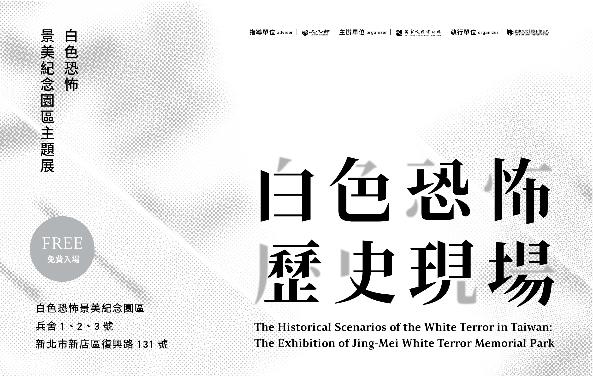
The Historical Scenarios of the White Terror in Taiwan: The Exhibition on Jing-Mei White Terror Memorial Park   Jul. 26th, 2021- Dec. 31st, 2021 Venue: National Human Rights Museum- Jing-Mei White Terror Memorial Park (131, Fuxing Rd., Xindian, New Taipei City, Taiwan)     The National Human Rights Museum is the first human rights museum in Asia to be located at the site of injustice. Since its establishment in 2018, it has taken "human rights" as its core value to restore and represent the space. Building it into a room for continuous dialogue and reflection is also an essential task of the National Human Rights Museum to promote transformational justice.   The thematic exhibition of Jing-Mei White Terror Memorial Park is knowledgeable and promotes the public's understanding of the authoritarian regime and allows mutually conflicting opinions obtained in the exhibition hall, providing an opportunity for communication.   The exhibition provides visitors with a structured and contextual introduction of the complex history of the White Terror era that is based on the viewpoint of human rights. It also tries to guide the audience to reflect on the connection with contemporary times after understanding the human rights violations of authoritarian rule.

What's On

2025-05-22

Building on the 2024 symposium theme, “Cultural Trajectories—Dialectics of Cultural Value: Dialogue and Practice,” the 2025 International Conference introduces “Cultural MBTI” as a conceptual framework for exploring the diverse forms, logics, and trajectories of culture in the present moment. “MBTI” here signals an invitation to rethink culture through the lens of variation, adaptation, and relationality—emphasizing how cultures perceive, react, evolve, and connect in response to shifting environments. Sub-theme 1: Cultural Multiple|The Plural Forms of Cultural Governance 1. Data-driven cultural policy and decision-making models 2. Decentralized and participatory governance mechanisms 3. Practical challenges and institutional design in local cultural governance 4. The impact of emerging technologies on cultural heritage management 5. Civic participation and practices of cultural democracy Sub-theme 2: Cultural Bridge|Bridging and Reconfiguring Cultural Values 1. The reconfiguration of cultural value and impact assessment in the age of technology 2. Financial sustainability practices for arts and cultural organizations within the creative economy 3. Ethical and intellectual property concerns of AI in content production 4. Cultural branding and city marketing through arts festivals and creative events Sub-theme 3: Cultural Transformation|Shifts and Co-Creation within the Cultural Ecosystem 1. Digital transformation and organizational innovation in arts institutions 2. Collaborative models for local revitalization and cultural regeneration 3. Ecosystem approaches to cultural sustainability 4. Social innovation and cultural interventions Sub-theme 4: Cultural Identity|Narratives and Imaginations of Identity 1. Decolonial practices and emerging multilingual cultural heritage policies 2. Digital technologies and their impacts on identity representation, heritage interpretation, and cultural equity 3. Museum exhibitions and the representation of ethnic diversity and the politics of memory 4. Community participation in shaping identities through performances and festivals Sub-theme 5: Cultural MBTI|Personality Typologies of Culture and Cultural Work 1. The “cultural personalities” and professional competencies of workers in the cultural and creative industries 2. The development of cultural leadership and vision 3. Comparative analyses of cultural labor conditions and policy recommendations Sub-theme 6: Open Topics|Expanding the Framework of Cultural MBTI This sub-theme invites experimental, interdisciplinary, and critical contributions that expand the Cultural MBTI framework. We especially welcome work addressing marginal, underexplored, or emerging cultural issues. Open Topics offers a space to explore culture as a dynamic intersection of knowledge, technology, and values. It encourages forward-looking perspectives and inclusive approaches to cultural practice and theory. Sub-theme 7: Approaches|New Thinking and Methodologies in Cultural Research and Practice This sub-theme explores emerging methodologies that reflect the evolving complexity of cultural research and practice. We invite contributions that draw on experimental formats, artistic methods, or non-representational theory (NRT). Approaches encourage cross-disciplinary dialogue and welcomes unconventional, practice-based, or non-verbal research. It aims to expand the methodological dimensions of the Cultural MBTI framework and bridge academic and professional inquiry. Sub-theme 8: Cultural Human Rights from an Asia Pacific Perspective A special session co-organized with the Federation of International Human Rights Museums-Asia Pacific (FIHRM-AP) 1. How can cultural governance defend and promote cultural human rights? 2. What are the implications of digital networks and AI for cultural rights? 3. Decolonial practices and cultural revitalization in the Asia-Pacific region 4. Labor rights and working conditions within the arts and cultural sectors Organizer: Graduate School of Arts Management and Cultural Policy, College of Humanities, National Taiwan University of Arts Dates: November 21 (Friday) – 22 (Saturday), 2025 Venue: International Conference Hall, 10th Floor, Teaching and Research Building, National Taiwan University of Arts Please visit the "2025 Cultural Trajectories Symposium Official Website" for more information

2024-10-18

Silent Erosion: Museums and Environmental Justice Editorial Notes Today’s rapid environmental changes and extreme weather events are having an overwhelming impact on society, the economy, and the environment. Now more than ever, it is crucial to consider how the power of museums and storytelling as well as making effective use of available tools and resources can raise public awareness about these environmental crises. This has become an important issue and a shared responsibility for all. This issue of FIHRM-AP, titled The Silent Erosion: Museums and Environmental Justice, focuses on how museums and archives can raise public awareness of environmental pollution and climate change by using their educational and promotional strengths to inspire reflection, dialogue, and proactive action. Visual storytelling also plays an important role in climate change awareness, as its powerful imagery and emotional impact help draw outside attention to local climate crises. The feature "Promotional Initiatives of the Minamata Disease Museum" highlights the educational outreach efforts of the Minamata Disease Center Soshisha in Japan. Activities including photo workshops and storytelling are helping participants learn about the history of Minamata disease. These efforts to engage with the public have encouraged people to consider the issues underlying environmental disasters and promoted understanding and reflection on environmental topics. The second article, "The Power of Visual Storytelling in the Times of Climate Crisis," introduces "Visualising Climate Crisis," a visual storytelling mentoring program by the NOOR Foundation, headquartered in the Netherlands. 12 visual storytellers from Southeast Asia were invited to document the destruction and challenges caused by climate change in order to bring attention to the connections between environmental changes and the fate of humanity. "A Case Study of NMNS's Special Exhibition ‘Climate Action: Our Future x Our Choice,’" a special article written by Associate Researcher Jhen-Yuan Yeh of the National Museum of Natural Science, examines from a museum’s perspective how such institutions can bring to life the abstract issue of climate change through exhibitions that merge both virtual and physical aspects. These exhibitions can better help visitors feel the urgency of the climate crisis and inspire them to take action. Faced with this silent but ongoing erosion of our environment, we must explore diverse approaches to drive change together and create a fairer and more just future for our planet.

2024-08-26

Stubborn Resistance: Museums during War and Conflicts Editorial Note The complex and volatile geopolitical environment of the Asia-Pacific region gives rise to frequent regional conflicts and human rights abuses, forcing upon many the fate of exile and displacement. The stories of those who have experienced such hardships have been recorded and disseminated through art exhibitions, museum collaborations, and community action, each voicing the resilience and determination of their creators. These collaborative initiatives are sometimes promoted through general museums or even by a single individual in the form of unconventional museums. This issue of FIHRM-AP features five articles on how efforts to resist the oppression of human rights are underway in Myanmar, Tibet, Hong Kong, and Cambodia. They not only reveal the tenacity and innovation of museums under the fire of conflict, but also how they have given voice to the exiled and oppressed. Through art and documentation, they etch their marks on history and evoke solidarity and support among more people. The first article, "Community-driven Memorialization and Identity Preservation of the Rohingya of Myanmar" by Rohingya Human Rights Network founder Raïss Tinmaung, discusses the crisis of identity erasure of the Rohingya people in Myanmar, the escalating ethnic cleansing and conflict, and the global Rohingya community's active efforts to digitally preserve village sites, identity records, and personal histories. The second article approaches from a perspective within Myanmar. Written by Aung Min, "Aung Mental Health Initiative: A Window to A long Rooted Complex Trauma in Myanmar" shares how Yangon residents, long shadowed by the stressors of conflict, have suffered from mental illnesses, drug abuse, and poverty. Through art therapy and film-making projects, Aung Clinic not only provides a more inclusive space for dialogue and expression for patients and their mental health but also documents the psychological landscape of Myanmar. The third news article is written by Wen-Hsin Chang, a research assistant in the exhibition team at the National Museum of Taiwan History. Titled "Diasporic Memories in Taiwan: Life Journey of Tibetans in Exile," Chang shares how the museum collaborated with the Tibetan exile community in Taiwan to hold workshops to narrate their personal exile experiences and paths of migration, shedding light on the complex marginalization faced by Tibetans due to political sensitivity and how it has forced many to remain hidden in society. The article "The 2023 Hong Kong Liberty Art Prize: Art and Human Rights Advocacy across Borders," written by curator Alric Lee, discusses how exhibitions are strategically leveraging resources in the Asia-Pacific region to promote human rights advocacy in the face of political pressure and the implementation of the National Security Law. Such regional cooperation has resulted in gained solidarity and support from many countries. The fifth article, "The Cambodian Landmine Museum: One Mine, One Life," is authored by long-time museum supporter Bill Morse. After the long civil war in Cambodia, tens of thousands of landmines were left behind. The museum, born out of the self-initiated removal of these landmines, is now dedicated to clearing out landmines, providing related education, and opening village schools.

Articles

2026-11-24

By Lin, Yu-Ting, Master’s Student, Graduate School of Arts Management and Cultural Policy, National Taiwan University of Arts Posters are among the visual media most closely woven into everyday life. They allow information to circulate in everyday settings and convey important messages at a glimpse through concise combinations of images and text. The Korea Democracy Foundation (KDF) is an institution established by the South Korean government in 2002 under a statutory mandate. It is dedicated to carrying forward the spirit of democracy, preserving historical records of democratic movements, and promoting human rights and civic education. In 2022, KDF launched the Democracy Poster Project, bringing together 50 artists and designers from around the world to produce a total of 100 posters responding to contemporary issues regarding democracy and human rights. This article traces the project’s development and transnational reach, drawing on a written interview between the author and Professor Moon-jung Jang (장문정), the project director, as well as supporting documents.

2026-11-23

By Lee, Yi-Hsuan, Master’s Student, Graduate School of Arts Management and Cultural Policy, National Taiwan University of Arts How Do We Perceive a History We Never Experienced? Memory anchors us to the past—yet how do we connect with a history we never lived through? Beginning in 1949, Taiwan entered a prolonged period of martial law and authoritarian rule, during which many people were arrested, detained, and tried by military courts for political reasons. For Generation Z, this history took place decades ago. Their knowledge of the White Terror comes mostly from textbooks, exhibitions, or the memories of those who came before. In Memory, History, Forgetting, Paul Ricoeur cited the writings of Vladimir Jankélévitch: “He who has been, from then on cannot not have been: henceforth this mysterious and profoundly obscure fact of having been is his viaticum for all eternity.” Living in a democratic society, most of us no longer have to fight so hard for our basic rights day after day. Nevertheless, the traumas of the past and the memories of those who suffered remain. How can we understand and remember these experiences, and use them as a reminder to confront future injustices and pursue justice? This remains an ongoing task for human rights education today. Art as a Medium: The Starting Point of the Human Rights Festival Since 2020, the National Human Rights Museum (NHRM) has held the Human Rights Festival annually at the Jing-Mei White Terror Memorial Park. In an interview, Chien, Sang-Jou of the Exhibition & Education Division from the Museum recalled that when the project was launched, the Museum was actively promoting human rights education in diverse ways. At the same time, the Museum began to consider a fundamental question: while human rights are deeply tied to everyone’s daily life, how could they find a medium to serve as a bridge to engage the public? In the end, the Museum chose art as its medium, focusing primarily on the performing arts. Unlike the Green Island Biennial [1], which is centered around visual art creation, the Human Rights Festival in Jing-Mei Memorial Park uses dance, music, promenade performances, and site-specific theaters, making art an accessible entry point for the public to connect with human rights issues. However, Jing-Mei Memorial Park is by no means merely a space for exhibitions and performances; it is a museum that preserves the historical site in situ, bearing the historical scars of the White Terror and the living memories of those who suffered. When artworks are presented in the park, their forms, content, and modes of viewer engagement must all respond to the history that once unfolded on this site. Therefore, the festival not only brings art into this historical site, but also aims to reconnect the past and present through art, encouraging viewers to reflect on the relationship between human rights and their own lives, grounded in the history of the site.  

2026-02-23

Author: Orca Huang, Collections Specialist, Hong Kong Action Archives Keywords: Hong Kong Action Archives, Archiving, Practice In an era when history is constantly being rewritten or erased, archiving has become a gentle yet steadfast form of resistance. Whether it is a banner left on the street or a manuscript on the verge of being forgotten, every preserved object is an attestation to the right to memory. Yet archiving is not merely a gesture. It involves significant demands on space, manpower, funding, and technical expertise. For organizations with limited resources, daily operations often resemble a tug-of-war with reality. Hong Kong Action Archives (hereinafter “HKAA”), an emerging community-led archival organization in Taiwan, held a panel discussion inviting three partners to share their practical experiences in managing archives and collections: Wei-Cheng Lin (林威城), Deputy Director of the Shung Ye Museum of Formosan Aborigines[1] (hereinafter “Shung Ye”); Li-Hsun Wang (王立勛), Executive Officer at the Special Collections Section of National Chengchi University Libraries[2] (hereinafter “NCCU Libraries Special Collections”); and Wan-Jung Wu (巫宛蓉) and Lu Huang (黃淥), conveners of the Lo-Sheng Stories and Archives Project[3] (hereinafter “Lo-Sheng”). The varied backgrounds of the panelists reflect HKAA’s eclectic approach: bridging the perspectives of a well-established private museum, an academic library with diverse holdings, and a resource-limited, grassroots archival team.